

How to Help Your Daughter Stop Being So Hard on Herself in Softball
Oct 01, 2026You ever watch your daughter make one mistake and suddenly, in her mind, the whole game is over? One strikeout. One error. One bad pitch. And here we go... "I suck." "I can't do anything right." "I'm the worst player out here." "Coach is probably going to take me out." Parents, meanwhile, you're sitting there thinking: Sis... you made ONE error. But to her? It doesn't feel like one error. It feels like everybody saw it. Everybody's thinking about it. Coach is mad. Her teammates are mad. You're disappointed.
And now she's mad at herself. If that sounds like your daughter, I want you to know something: Being hard on herself doesn't automatically mean she has a bad attitude. A lot of times, it means she really cares. She wants to be good. She doesn't want to disappoint people. She has expectations for herself. Those things aren't bad. But sis, we've gotta learn how to care about getting better without beating ourselves up every time we're not perfect.
Because softball? Softball is going to humble you. And if every mistake turns into a conversation about how terrible you are, this game is going to feel a whole lot heavier than it needs to.
Caring Without Tearing Yourself Down
The problem starts when: "I want to do better" turns into: "I'm not good enough." Those are completely different conversations. Sis, I'm all for holding yourself accountable. If you didn't prepare, let's talk about it. If your effort wasn't there, let's fix it. But calling yourself terrible isn't accountability. That's just tearing down the person we're trying to build up. Instead of: "What's wrong with me?" Ask: "What can I learn from this?"
Listen to How She Talks to Herself
Would you talk to your teammate the way you talk to yourself? Your teammate strikes out. Would you walk over and say: "Wow. You suck." "You always mess up." "You'll probably do it again." Hopefully not. So why is that okay when you're talking to yourself? Sis, you're on your team too.
Parents Listen Before You Correct
Your daughter says: "I'm terrible." Most parents immediately respond: "No you're not!" That's understandable. But instead of immediately arguing with her feeling, try getting curious. "What happened that made you feel that way?" Then let her talk. Maybe she struck out. Maybe another girl played her position. Maybe she got yelled at. Maybe she thinks she disappointed her coach. Maybe another player made a comment. Now you're dealing with what's actually underneath the statement.
You're not agreeing that she's terrible. You're teaching her how to understand what she's feeling.
Separate the Fact From the Story
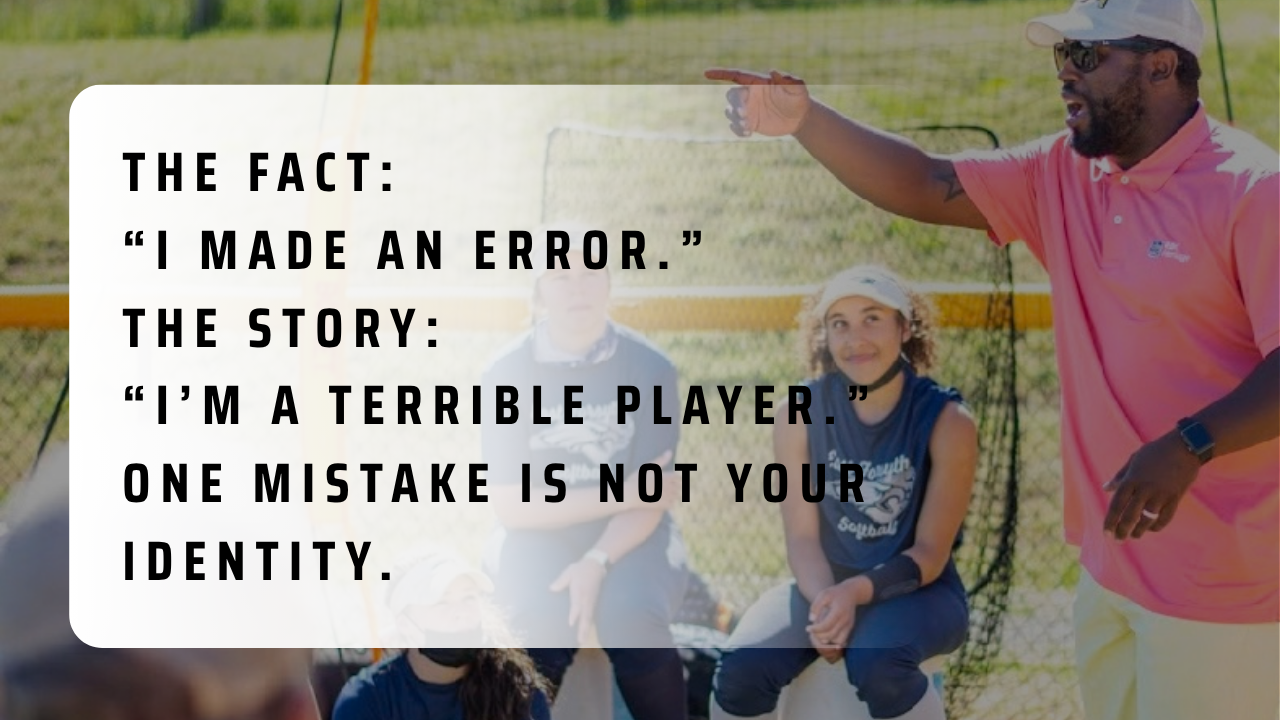
She made an error. That's the fact. Then her brain adds the story: "I always make errors." "Coach can't trust me." "I'm going to get benched." "Everybody thinks I'm bad." Hold up, sis. What actually happened? You made an error. That's it. We can work with that. FACT "I struck out." from: STORY "I'm a terrible hitter." Or: FACT "I walked two batters." STORY "I can't pitch."
Choose Progress Over Perfection
You're going to make outs. You're going to swing and miss. You're going to throw balls. You're going to make errors. You're going to have games where you're just... off. Welcome to softball, sis. If your definition of success is: "I don't make mistakes," you're setting yourself up to feel like a failure constantly. Instead, redefine a successful competitor: I prepare. I compete. I adjust. I respond. That's something she can actually control.
Watch What Gets Praised at Home
If the biggest celebration always comes after: Home runs. Great pitching performances. Wins. Big hits. Perfect games. Then the player can start believing: Results = approval. Celebrate that bomb! Celebrate the strikeouts! Have fun. But also notice: "I loved how you came back after that error." "I saw you encouraging your teammate." "You looked nervous and stepped in there anyway." "I could tell you've been working on that." "I loved your energy in the dugout."
Now she's learning there are lots of ways to be successful.
Give Her a Simple Reset
Something SIMPLE. Not a 14-step routine she's trying to remember while there's a runner stealing second. Something like: Breathe. Reset word. Next play. 1. BREATHE One breath. 2. SAY IT "Next play." 3. MOVE Physically get ready for what's next. That's it. Sis, we don't have time to hold a meeting with ourselves in the middle of the inning. The next pitch is coming.
Stay Steady After Her Mistake
Your daughter makes an error. She's upset. You're upset because she's upset. Then you start trying to fix it. And now everybody's emotional. Parents, stay steady. Her mistake doesn't have to become a family emergency. If you're calm, you're communicating: "This is something you can handle." That's a much more powerful confidence message than trying to rescue her from every uncomfortable feeling.
Use Language That Leaves Room to Grow
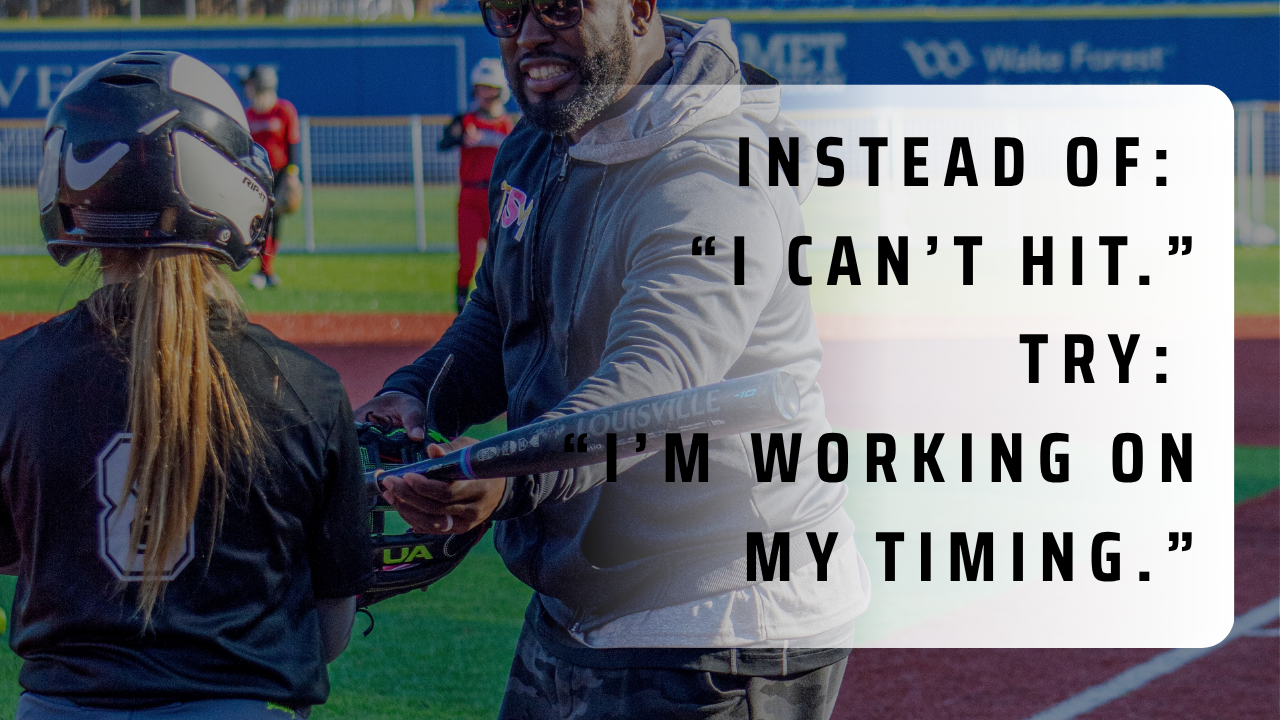
Instead of: "I suck." Try: "I'm struggling with this right now." Instead of: "I can't hit." Try: "I'm working on my timing." Instead of: "I always mess up." Try: "I made a mistake. Next play." Instead of: "Everybody is better than me." Try: "What can I work on?" That little word "right now" can be powerful too. "I can't do this." becomes: "I can't do this yet." Now there's somewhere to go.
Help Her Notice Her Progress
Young athletes can be really good at remembering every failure and forgetting how far they've come. Sis, sometimes you need receipts. Go look at where you were six months ago. What can you do now that you couldn't do then? What used to scare you that doesn't anymore? What have you worked through? Confidence grows when girls can actually see their growth. That's why progress matters more than perfection.
Respond When She Says She Is Terrible
Try: "What happened that made you feel that way?" Then listen. Follow with: "Okay. What's the part we can actually work on?" Or: "Is this something you need to practice, or are you just disappointed right now?" Or simply: "Do you want me to listen, or do you want help?" The goal isn't to win an argument and convince her she's amazing. The goal is to help her move from: emotion to understanding to action.
A Message for the Player Who Is Too Hard on Herself
Sis, listen to me. Wanting to be great isn't the problem. Working hard isn't the problem. Having big goals definitely isn't the problem. I WANT you dreaming big. But we're not going to tear ourselves down trying to build ourselves up. That doesn't make any sense. You're going to strike out. You're going to mess up. You're going to have days where you don't look anything like the player you know you can be. And guess what? You're still her.
One game didn't take your talent away. One error didn't erase your work. One coach's decision doesn't determine your future. One bad weekend doesn't get to write your whole story. Learn. Adjust. Work. And then keep moving. Come on, sis. Next play.
Frequently Asked Questions
Why is my daughter so hard on herself in softball?
She may care deeply, fear disappointing others, or connect mistakes with her value as a player. Help her describe the specific event instead of turning it into a judgment about who she is.
How do I respond when my daughter says she is terrible at softball?
Ask what happened that made her feel that way. Listen first, then help her identify whether she needs support, practice, or time to process disappointment.
How can a player stop negative self-talk after an error?
Use a short reset: breathe, name the fact, give one useful instruction, and prepare for the next play. The goal is useful self-talk, not forced positivity.
Should parents correct negative self-talk immediately?
Do not argue with the feeling before understanding it. Ask a calm question, listen, and then help the player replace the harsh statement with specific and accurate language.
How can young softball players become mentally tougher?
They can practice resetting, focusing on controllable actions, asking for help, and responding to mistakes without turning them into labels.
Keep Building with CJ
If your daughter is ready to keep building her skills, confidence, and mindset, come join us inside the CJ Beatty Softball Academy. We are putting in the work and becoming better players and people together.
Don't miss a beat!
New moves, motivation, and classes delivered to your inbox.
We hate SPAM. We will never sell your information, for any reason.