

How to Help a Young Softball Player Overcome Fear of Failure
Oct 01, 2026You ever watch a player who looks completely different in practice than she does in a game? Practice? Sis is loose. She's swinging hard. She's making plays. She's talking. She's having fun. Then game time comes around and... Everything gets tight. She's thinking instead of playing. She's scared to swing at strike three. She's afraid to throw the ball because she might make an error. She's looking over at Coach after every mistake. She's looking at Mom and Dad in the stands.
And instead of thinking: "Let's go make a play." She's thinking: "Please don't let me mess up." That's fear of failure. And here's what I want young softball players to understand: Being afraid doesn't mean you're weak. It means you care about what happens. But sis, we can't let fear make all our decisions. Because if your whole game becomes about not messing up, you're going to have a hard time becoming the player you're capable of becoming.
We're not trying to get rid of every nervous feeling. We're learning how to compete with it.
Recognize What Fear of Failure Looks Like
This is important for parents. A young player usually doesn't walk up and say: "Mom, I'm experiencing a fear of failure." Nah. It might look like: "I don't want to go to practice." "My stomach hurts." "I don't want to bat." "I don't want to pitch." "Can I play outfield instead?" "That coach doesn't like me." "I don't care." Or maybe she starts crying after mistakes. She gets angry. She shuts down. She makes excuses. She stops taking chances.
She suddenly doesn't want to try something she used to love doing. Before labeling it a bad attitude, ask: "Is she afraid of what might happen if she fails?" Sometimes what looks like an attitude problem is a player trying to protect herself.
Accept That Failure Is Part of Softball
We've gotta get this one out of the way. If you want to play softball without failing... I don't know what to tell you, sis. You picked the wrong sport. You're going to strike out. You're going to make errors. You're going to walk batters. You're going to get caught stealing. You're going to miss signs. You're going to have bad games. You might even have a whole bad weekend. That's softball. The goal isn't to become a player who never fails.
That player doesn't exist. The goal is to become a player who knows what to do when failure shows up. That's a completely different mindset.
Stop Playing Not to Make a Mistake
There's a huge difference between: Playing to make something happen and playing so nothing bad happens. Think about the hitter who's afraid to strike out. She gets two strikes and suddenly the goal changes. She's not thinking: "Drive the ball." She's thinking: "Don't strike out." Now she's defensive. She's hesitant. She's worried about the result before the pitch even gets there. Or think about the infielder who's already made an error.
The next ball gets hit to her and instead of: "I want it." her brain goes: "Please don't hit it to me." Sis... We can't play like that. Great players aren't great because they're never afraid of failing. They learn how to stay aggressive even when failure is possible.
Ask What She Is Actually Afraid Of
Parents, this conversation can tell you a lot. Ask: "What's the worst part about making a mistake?" And then listen. You may be surprised by the answer. Maybe she's afraid Coach will yell at her. Maybe she's afraid she'll get benched. Maybe she thinks her teammates will be mad. Maybe she's worried you'll be disappointed. Maybe she's afraid she'll embarrass herself. Maybe she thinks making mistakes means she isn't as good as everyone thinks she is.
Now we're getting underneath the fear. Because sometimes she's not really afraid of striking out. She's afraid of what she thinks the strikeout means. That's what we need to work on.
Parents Check the Pressure Around Her
This one may be uncomfortable. But it's worth asking. Does your daughter feel safe failing around you? Not physically safe. Emotionally safe. When she makes a mistake, what happens? Does she immediately look toward the stands? Does she know from your face that you're frustrated? Is there a lesson waiting for her in the car after every game? Does every tournament become an evaluation? Does every at-bat need to be analyzed? Parents, I know why we do it.
You care. You're invested. You're spending time and money. You see what she's capable of. But sometimes our desire to help can accidentally create more pressure. She doesn't need to believe: "If I mess up, Mom or Dad is going to be upset." She needs to know: "My parents believe I can handle hard things." That's different.
Choose Brave Over Perfect
I want young players chasing brave, not perfect. Perfect says: "I can't make an error." Brave says: "Hit it to me again." Perfect says: "I can't strike out." Brave says: "I'm taking my swing." Perfect says: "I can't walk anybody." Brave says: "Next pitch. Attack." Perfect says: "I can't let anybody see me struggle." Brave says: "I'm still learning." Sis, perfect is exhausting. Let's be brave instead.

Set Goals She Can Control
Fear gets bigger when the goal is completely result-based. "I HAVE to get a hit." "I HAVE to strike her out." "We HAVE to win." "I HAVE to make the team." Those are outcomes. She can influence them, but she can't completely control them. Give her something she owns. For a hitter: See the ball. Be on time. Take my swing. For a pitcher: Trust my pitch. Attack the zone. One pitch at a time. For a defender: Ready every pitch. Want the ball.
Next play. Now we're giving her brain a job instead of giving it something to worry about.
Act Before Confidence Arrives
This is one of the biggest lessons I want girls to learn. You don't have to wait until you're confident to do the thing. Sometimes you do the thing... and confidence comes later. You're nervous about trying out? Go anyway. You're scared to face the fast pitcher? Get in the box. You're afraid you'll mess up at shortstop? Say: "Hit it to me." You're nervous about speaking up? Use your voice anyway. That's how courage works. Courage isn't: "I'm not scared."
Courage is: "I'm scared, and I'm going anyway." SCARED? GO ANYWAY. FACE IT. DO IT ANYWAY.
Let Her Learn From Failure
This is hard for parents. You see your daughter hurting and your instinct is: Fix it. Call the coach. Explain what happened. Tell her why it wasn't her fault. Give advice. Make her feel better. But every age-appropriate struggle doesn't need an adult solution. Sometimes the lesson is: "That hurt... and I survived it." That's powerful. She didn't make the team. She can recover. She struck out with the bases loaded. She can recover. She got pulled from the circle.
She can recover. She made an error that cost her team a run. She can recover. That's resilience. We don't build resilient athletes by removing every hard experience. We help them learn how to move through hard experiences.
Build a Next Play Mentality
The players who handle failure well aren't necessarily less disappointed. They've just learned how to move forward faster. Error? Next play. Strikeout? Next at-bat. Bad inning? Next inning. Bad game? Next opportunity. We're not pretending it didn't happen. Learn what you need to learn. Then quit dragging the last play into the next one. Sis, you can't change the pitch that's already been thrown. But you sure can compete on the next one.
Watch How Adults Talk About Failure
Young players listen to us. If adults talk like every mistake is a disaster, kids learn to treat mistakes like disasters. If we constantly say: "You can't make that error." "You have to get that bunt down." "You should've caught that." "You can't walk the leadoff hitter." We're putting the player's attention on avoiding failure. Try changing some of the language. "Trust your work." "Compete." "Stay aggressive." "What did you learn?" "What can you control next?"
We're not lowering expectations. We're teaching her where to put her attention.
Collect Evidence That She Can Handle Hard Things
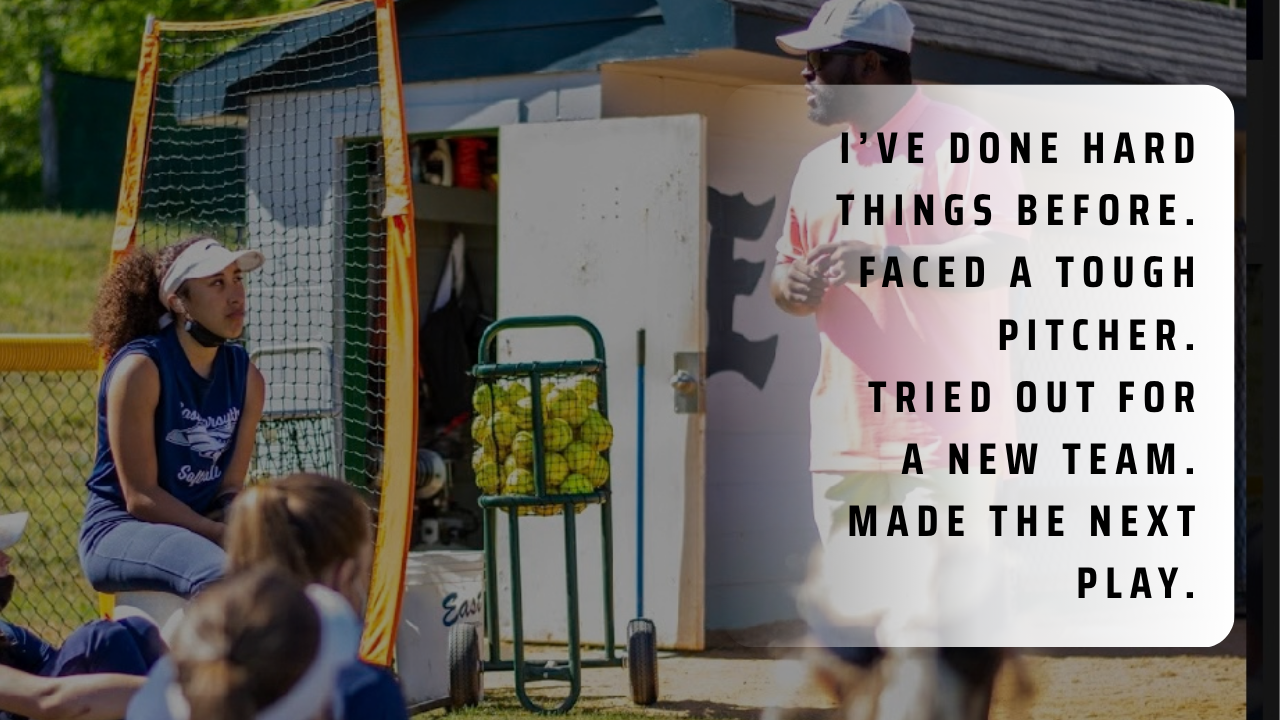
Have her write down moments when she was scared, nervous, disappointed, or uncomfortable and did it anyway. Maybe: She faced the hardest pitcher she's ever seen. She tried out for a new team. She pitched after giving up a home run. She spoke to her coach herself. She came back after an injury. She made an error and made the next play. She struck out twice and got a hit in her third at-bat. Those become receipts. The next time fear shows up, she can remind herself: "I've done hard things before."
That's real confidence.
What Parents Can Say
Try questions instead of speeches. "What are you worried might happen?" "What part of this can you control?" "What would brave look like right now?" "What have you done to prepare?" "What's one thing you can focus on?" And one of my favorites: "What would you do if you weren't afraid of messing up?" That question can tell you a lot.
A Message for the Player Who Is Afraid to Mess Up
Sis, listen. You are going to fail. I know. Great motivational speech, right? But I'm serious. You're going to mess up. So am I. So is your coach. So are your teammates. So are your parents. Everybody you look up to has failed at something. The question isn't: "How do I make sure I never fail?" The question is: "Who am I going to become when I do?" Are you going to hide? Are you going to quit? Are you going to stop taking chances because you're scared somebody might see you struggle?
Or are you going to learn? Adjust? Get back up? And go again? You don't need to wait until you're fearless. Do it scared. Walk up. Take your swing. Throw your pitch. Ask the question. Try out for the team. Want the ball. Whatever your thing is... Face it. Do it anyway. That's how we grow around here, sis.
Frequently Asked Questions
Why is my daughter afraid to make mistakes in softball?
She may fear embarrassment, disappointing adults, losing playing time, or proving a negative belief about herself. Ask what she thinks will happen if she makes a mistake.
How can I help my daughter overcome fear of striking out?
Shift the goal from avoiding a strikeout to competing through the at-bat. Focus on her plan, pitch selection, and response rather than demanding a result.
Why does my daughter play better in practice than in games?
Games add evaluation, consequences, and attention. Practice brave actions under pressure and give her a simple game-day focus she can control.
How can parents reduce pressure on young softball players?
Keep love and approval separate from results, avoid sideline coaching, praise brave and controllable actions, and let the player own her experience.
What is the difference between confidence and courage in softball?
Confidence is trust built from preparation and experience. Courage is taking the next useful action even when confidence is not fully present.
Keep Building with CJ
If your daughter is ready to keep building her skills, confidence, and mindset, come join us inside the CJ Beatty Softball Academy. We are putting in the work and becoming better players and people together.
Don't miss a beat!
New moves, motivation, and classes delivered to your inbox.
We hate SPAM. We will never sell your information, for any reason.