
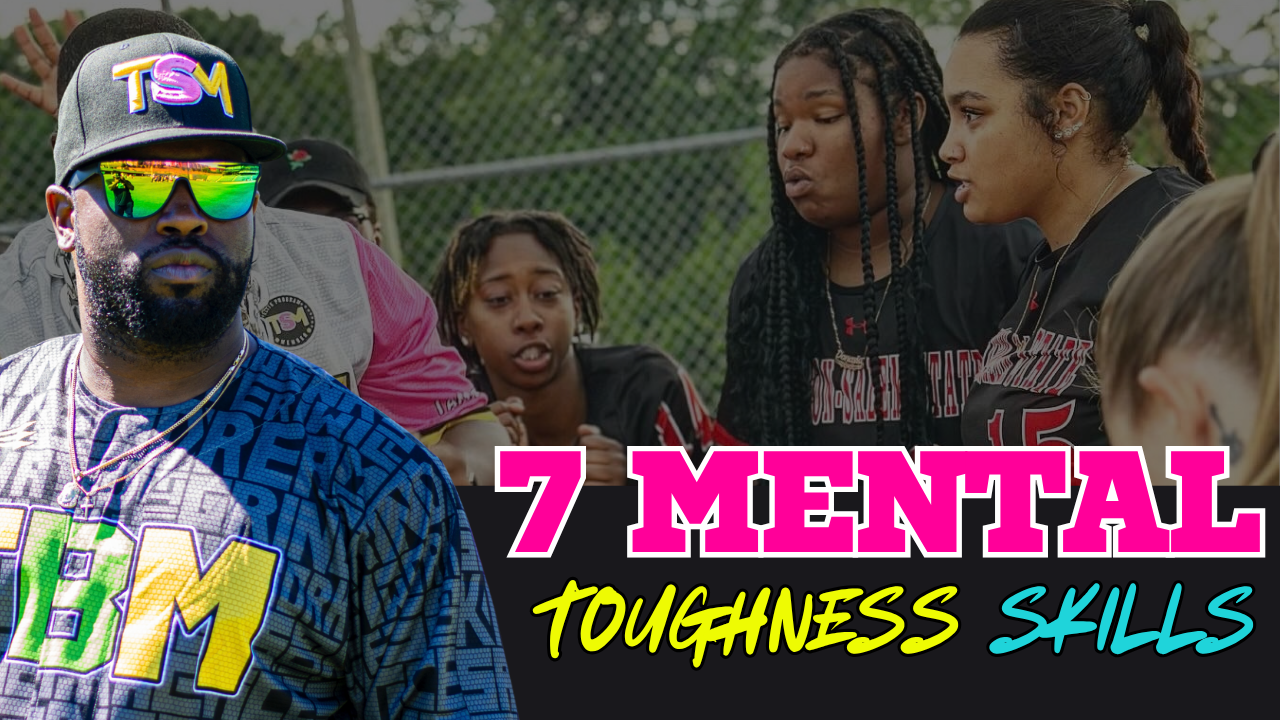
Mental Toughness in Softball 7 Skills Every Young Player Needs
Oct 01, 2026When people hear "mentally tough softball player," sometimes they picture the girl who never cries. Never gets nervous. Never gets frustrated. Never gets upset. Nothing bothers her. Nah. That's not what we're talking about. Sis, you're allowed to have emotions. You're allowed to be disappointed. You're allowed to be nervous before a big game. You're allowed to be mad that you struck out. You're allowed to have a moment when softball feels HARD.
Mental toughness isn't pretending you don't feel anything. It's learning what to do with those feelings when they show up. Can you strike out and compete in your next at-bat? Can you make an error and still want the next ball? Can you sit the bench and still be a great teammate? Can you be nervous and step into the circle anyway? Can you have a bad weekend without deciding you're a bad softball player? Now we're talking about mental toughness.
And here's the good news: Mental toughness is a skill. Which means we can work on it. Let's talk about seven things I want every young softball player learning.
Skill 1 Control What You Can Control
Sis, there are a whole lot of things in softball you cannot control. The umpire. The lineup. Playing time. What position Coach puts you at. How good the other team is. Whether somebody makes an error behind you. What another parent says. What your teammate thinks. Whether the ball you absolutely SMOKED goes right at the center fielder. That's softball. But you know what you do control? Your effort. Your preparation. Your attitude. Your body language.
Your response. Your next decision. Mentally tough players get really good at knowing the difference. Because when you're spending all your energy fighting things you can't control, you don't have much energy left for the things you actually can.
Parents Focus on Controllable Actions Too
Pay attention to what we talk about after games. If the whole conversation is: "The umpire was terrible." "Coach should've played you." "That other girl shouldn't be ahead of you." "Your teammates didn't help you." We're teaching her to look outside herself. Sometimes those things may even be true. But the better question is: "What part of today could you control?" That's where her power is.
Skill 2 Learn How to Reset
This might be one of the most important mental skills in softball. Because the game doesn't wait for you to finish being upset. You boot the ground ball? Here comes the next pitch. You give up a home run? You've still gotta pitch to the next hitter. You strike out? Eventually, you're getting another at-bat. You can't drag the last play around with you all game. Sis, that thing gets HEAVY. Mentally tough players develop a reset. Keep it simple: Breathe.
Reset. Next play. Maybe your word is: NEXT. Maybe it's: FLUSH IT. Maybe it's: I GOT THIS. Whatever works for you. The point isn't pretending the mistake didn't happen. We can learn from it later. Right now? We've got another pitch to play.
Skill 3 Use Helpful Self Talk
We've talked about this before because it's THAT important. Your brain hears you. And some of y'all are talking crazy to yourselves. One strikeout and suddenly it's: "I can't hit." One walk and: "I can't pitch." One error and: "I always mess up." Come on, sis. Would you say that to your teammate? Then don't say it to yourself. Mental toughness doesn't mean filling your head with fake positivity either. You don't need: "I AM THE GREATEST PLAYER IN THE WORLD!"
when you're having a rough day. You need something useful. Instead of: "I can't hit this pitcher." Try: "See it. Compete. One pitch." Instead of: "I can't make another error." Try: "Want the ball." Instead of: "I have to strike her out." Try: "Attack." Simple. Useful. Something your brain can actually do something with. And remember: Sis, you're on your team too. Talk to yourself like it.
Skill 4 Get Comfortable Being Uncomfortable
You know where a lot of growth happens? Right outside that comfortable little bubble we all like hanging out in. Tryouts can be uncomfortable. Facing a great pitcher can be uncomfortable. Pitching in a championship game can be uncomfortable. Playing a new position can be uncomfortable. Talking to your coach can be uncomfortable. Joining a new team where you don't know anybody? Definitely uncomfortable. But here's the problem: If you only do things when you feel completely comfortable, you're going to miss a whole lot of opportunities to grow.
Mental toughness is learning: "I can feel uncomfortable and still do this." Not: "I'm not nervous." But: "I'm nervous. Let's go anyway." That's courage. And every time you do something difficult without running from it, you're building evidence. I've handled hard things before. That's where real confidence starts growing.
Skill 5 Learn From Failure
I got some bad news for you, sis. If you're planning on playing softball for a while... You're gonna fail. A lot. Welcome to the game. You're going to strike out. You're going to make errors. You're going to have bad tournaments. You're going to lose. You might not make a team you really wanted to make. You might lose your starting spot. You might get pulled from a game. And none of those things feel good. Mental toughness isn't smiling and pretending you don't care.
You SHOULD care. The question is: What do you do next? Failure can make you quit. Or failure can teach you. Mentally tough players start asking: What happened? What can I learn? What can I control? What am I going to do next? That's how failure becomes fuel instead of a label.
Skill 6 Be a Great Teammate When It Is Not About You
Okay, sis. This one matters. It's easy to be loud in the dugout when you just hit a double. It's easy to celebrate when you're pitching. It's easy to have great body language when you're starting at shortstop. But what about when you're not playing? What about when another girl gets the position you wanted? What about when your teammate hits the home run and you went 0-for-3? What about when Coach takes you out? Who are you then? That's mental toughness too.
Can you celebrate somebody else when you're disappointed for yourself? Can you stay engaged? Can you encourage your pitcher? Can you pick up your teammate after she makes an error? Can you still bring energy to the dugout? You don't have to pretend you're happy about sitting. But you do have control over what kind of teammate you become while you're there. And trust me... People notice. Coaches notice. Teammates notice. And more importantly, you'll know.
That's Bigger Than the Game.

Skill 7 Keep Showing Up
This one isn't flashy. Nobody's making a highlight reel about it. But it matters. Keep showing up. When you're playing great? Show up. When you're struggling? Show up. When you're confident? Show up. When you're questioning yourself? Show up. When practice is fun? Show up. When you're working on something that you're terrible at right now? Show up. There are going to be times when softball doesn't feel amazing. You're not going to be motivated every day.
That's normal. The players who grow learn how to keep working even when the excitement isn't there. Not because somebody is forcing them. Because they decided: "This matters to me." That's where discipline starts.
Mental Toughness Does Not Mean Doing It Alone
This part is important. Being mentally tough does NOT mean: "I can't ask for help." "I can't tell anybody I'm struggling." "I can't cry." "I have to figure everything out myself." Nope. Sometimes the mentally tough thing to do is tell your parent: "I'm having a hard time." Sometimes it's asking Coach: "What can I work on?" Sometimes it's talking to somebody you trust. Sometimes it's taking a break. Sometimes it's admitting: "I don't know what to do next."
Strong people ask for help too. Remember that.
Parents Build Skills Without Making Everything Harder
This is another misconception. We're not trying to make our kids tougher by being harder on them every time something goes wrong. Young athletes need accountability. Absolutely. But they also need a safe place to learn. There's a difference between: "You need to toughen up." and: "This is hard. What do you think you can do next?" One shuts the conversation down. The other teaches her how to think. We're trying to raise players who eventually know how to coach themselves through difficult moments.
That takes practice. So instead of solving every problem for her, ask questions. "What can you control?" "What did you learn?" "What would you do differently?" "What do you think your next step should be?" Let her think. Let her struggle a little. Let her find some answers. That's part of growing up.
A Simple Mental Toughness Check
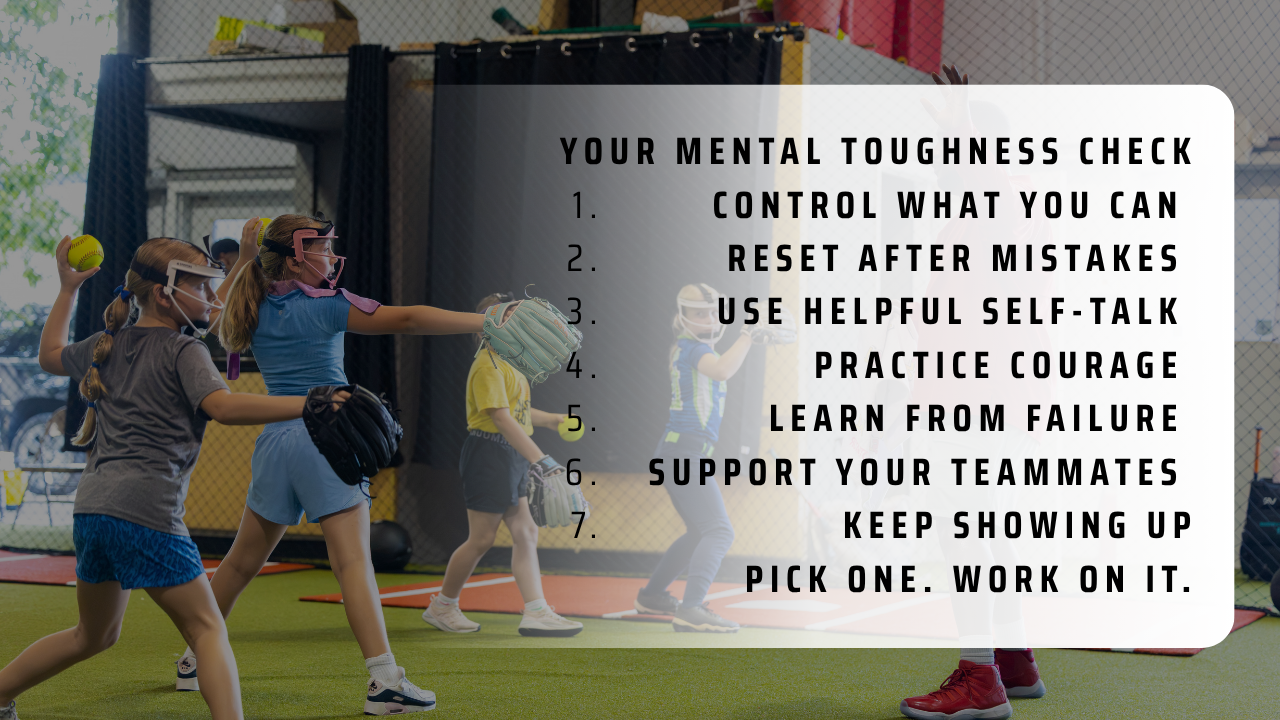
Sis, here's something you can put in your CJ's Chickens Playbook. After a tough game, practice, or tournament, ask yourself: Did I control what I could control? Did I reset after mistakes? Did I talk to myself like a teammate? Did I do something uncomfortable? Did I learn from failure instead of running from it? Was I a good teammate even when things weren't going my way? Did I keep showing up? You're not going to answer yes to all seven every time.
That's okay. Pick one. Work on it. Then come back again. That's how we build this thing.
What Mental Toughness Looks Like in Real Life
Mental toughness isn't always some huge championship moment. Sometimes it looks like the girl who struck out three times but still wants the fourth at-bat. Sometimes it's the pitcher who walked two hitters and takes a breath before attacking the next one. Sometimes it's the player sitting on the bench cheering for the girl playing the position she wanted. Sometimes it's the kid who didn't make the team and decides to go back to work. Sometimes it's the girl who finally tells somebody: "I'm struggling and I need help."
Those moments might never make a highlight video. But those are the moments building the person underneath the jersey. And that person matters a whole lot more than today's box score.
A Message for the Player Who Wants to Be Mentally Tougher
Sis, I don't need you to be a robot. I don't need you to never cry. I don't need you to never get nervous. And I definitely don't need you pretending everything is okay when it isn't. I want you learning how to respond. Bad play? What's next? Bad game? What did we learn? Nervous? Let's go anyway. Something you can't control? Leave it alone. Teammate struggling? Pick her up. You're struggling? Ask for help. That's mental toughness. It's not about being perfect.
It's not about never feeling anything. It's knowing that when softball gets hard... you don't have to fall apart or run away. You can breathe. You can reset. You can learn. You can ask for help. You can keep going. And every time you do? You're building something softball can't take away from you. That's Bigger Than the Game, sis.
Frequently Asked Questions
What does mental toughness mean in softball?
Mental toughness is the ability to respond usefully to pressure, mistakes, disappointment, and discomfort. It does not mean ignoring emotions.
How can a young softball player become mentally tougher?
Practice controllable skills such as resetting, useful self-talk, preparation, asking for help, and staying engaged after difficult plays.
How can parents help build mental toughness?
Ask questions that help the player think, allow manageable struggle, praise responses and effort, and avoid treating every mistake as an emergency.
How can a softball player stop overthinking during games?
Use a short cue tied to the next action, such as "see it," "attack," or "next pitch." Simple instructions keep attention in the present.
Is confidence the same as mental toughness?
No. Confidence is trust in your ability and preparation. Mental toughness is the set of skills used to respond when confidence drops or the game becomes difficult.
Keep Building with CJ
If your daughter is ready to keep building her skills, confidence, and mindset, come join us inside the CJ Beatty Softball Academy. We are putting in the work and becoming better players and people together.
Don't miss a beat!
New moves, motivation, and classes delivered to your inbox.
We hate SPAM. We will never sell your information, for any reason.